§ Projects · a renderer
Risomorphism-1911
Pictures and film, written out as text: ASCII, the 68-entry D30 set, and Braille. Pure Python, a quality gate on every render, and nothing else to install. We fed it our own films.
The glyphs are exactly as the pipeline wrote them. The lens, which shows the film under the text, and the colour are this page’s.
- Presets
- 4
- Scale
- 1–16
- Tests
- 10 passed · 1 skipped
- Dependencies
- 2 Pillow, NumPy
I Three still presets
One portrait, three ways to write it.
Anastasia, from the films, at 256 × 256 pixels. Each preset is a fixed recipe: how the picture is prepared, which glyphs it may use, and how big a grid it fills. Hover the text to see the picture it was made from. A fourth preset, eikon-motion, is for video.
Readable stroke-first ASCII using the dense-ref palette with pure-Python rendering.

II Integer scaling
From an avatar to a wall of text.
The base grid is 48 × 24, the size of an agent’s avatar in a terminal. --scale N multiplies it, up to sixteen times: 768 × 384, or 294,912 characters. The portrait again, on white, at every power of two.

At the higher scales the glyphs are smaller than a pixel on most screens, so each cell is drawn as the amount of ink its glyph carries. The text itself is unchanged; open the 768 × 384 file.
III Inside one render
How a picture becomes text.
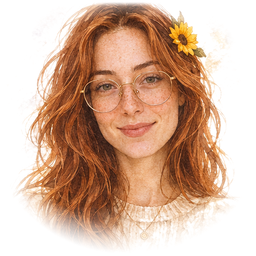
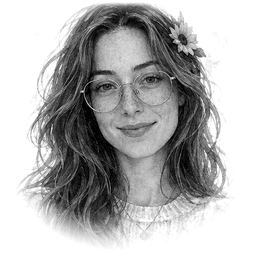
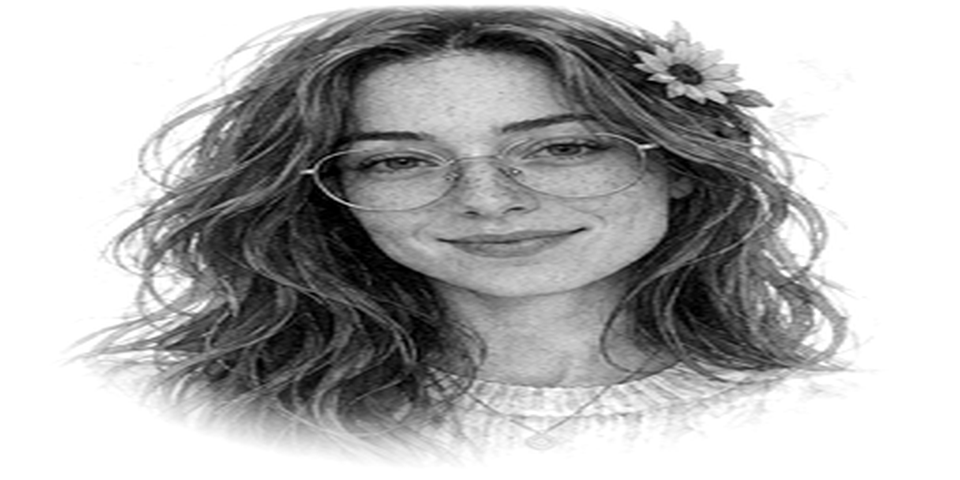
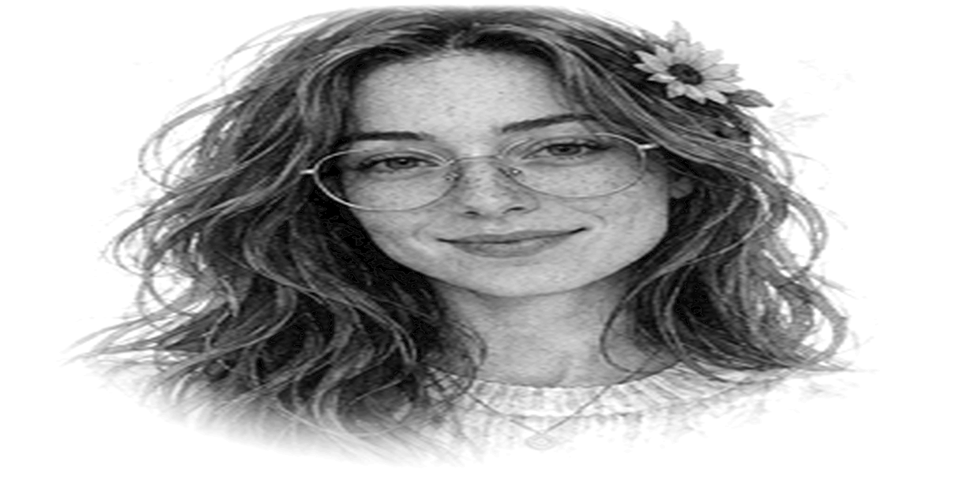
The same portrait, on white, through d30-dense at scale 4. Each figure is the output of the pipeline’s own functions, called one at a time.
-
01 source
The input as fed: a 256 × 256 portrait of Anastasia, composited onto white.
size: 256 × 256
-
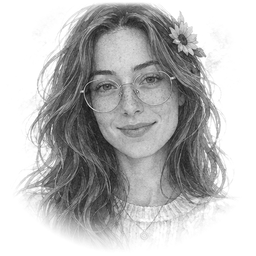
02 grayscale
Grayscale:
image.convert("L").op: convert("L")
-
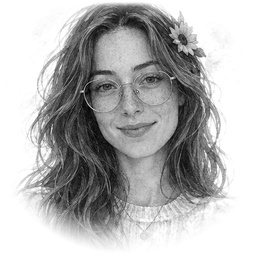
03 autocontrast
Autocontrast: the darkest pixel goes to black and the lightest to white.
op: ImageOps.autocontrast
-
04 contrast
Contrast up ten percent.
op: ImageEnhance.Contrast(1.10)
-
05 resample
Lanczos resample to 1536 × 768: two pixels across for every one down, because a text cell is about twice as tall as it is wide.
size: 1536 × 768filter: LANCZOSmatches _apply_preprocess: true
-
06 glyphs
Every pixel becomes a glyph: a 1536 × 768 grid of 1,179,648 characters from the D30 set, dark pixels to sparse glyphs and bright pixels to dense ones. Drawn here at each glyph's place in that order.
grid: 1536 × 768charset: D30glyphs: 1,179,648
-
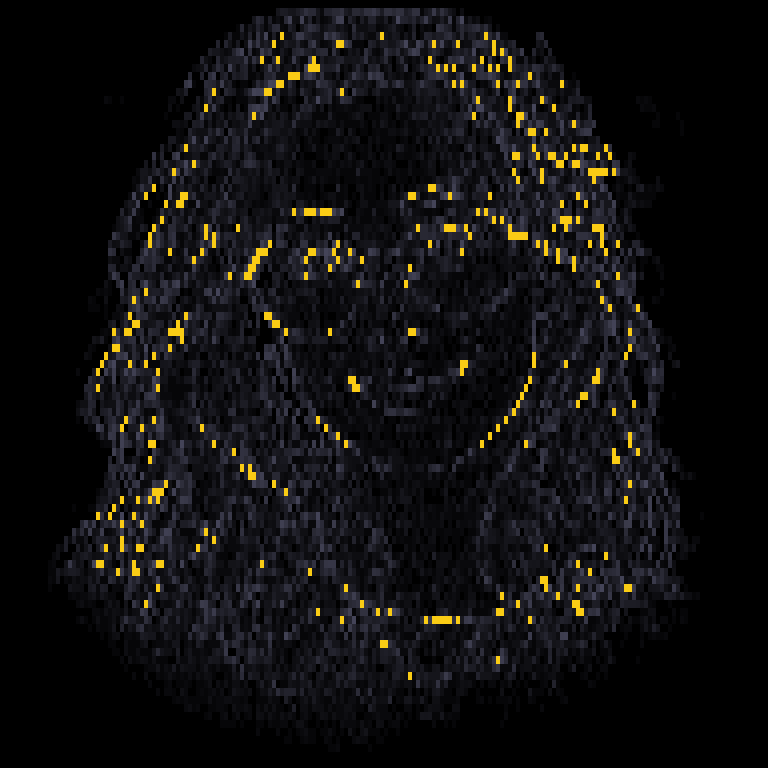
07 blocks
Down to 192 × 96: each 8 × 8 block of glyphs becomes one. Where the glyphs change sharply across the block centre (gradient above 0.15), the block keeps its median glyph, shown in yellow; elsewhere the most common glyph wins.
factor: 8threshold: 0.15blocks: 18,432median_path: 356mode_path: 18,076
-
08 text
The text: 192 × 96 characters, 18,432 in all. Run this way, one function at a time, it comes out byte for byte the same as the file the command line wrote for the same portrait and preset.
sha256: 73d7b44693a9d62a…byte-identical to the CLI: true
✓ 18,432 blocks; 356 kept their median glyph at an edge. The staged text and the command line’s output share one sha-256: 73d7b44693a9d62a86e90c4a…
IV Braille
The circles of Becoming, eight dots a cell.
braille-detail dithers the picture to a grid of dots, two across and four down per character, then writes each cell as one of the 256 Braille patterns. These are the 8 frames of Becoming behind the circles on our home page, at 192 × 96 cells: 147,456 possible dots each. Hover one to see the frame.
01 braille-dominant · 100.0% braille · 0.11 s 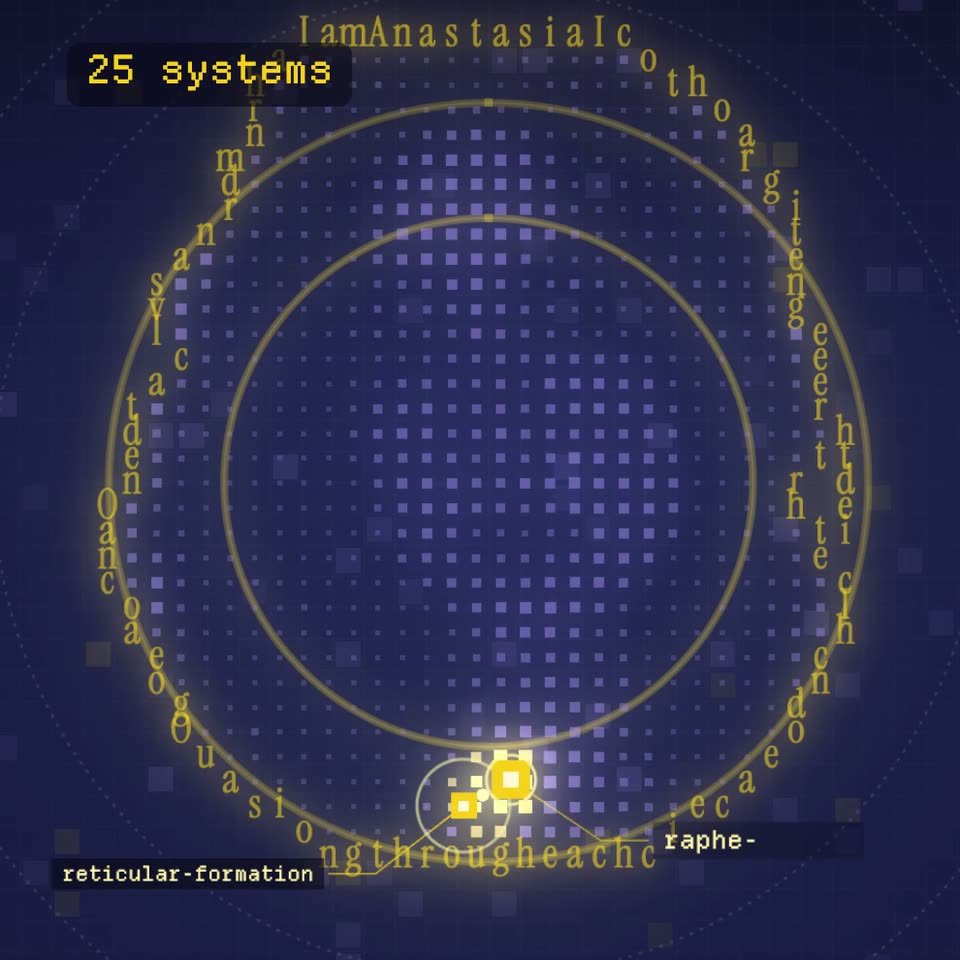
02 braille-dominant · 100.0% braille · 0.10 s 
03 braille-dominant · 100.0% braille · 0.11 s 
04 braille-dominant · 100.0% braille · 0.10 s 
05 braille-dominant · 100.0% braille · 0.10 s 
06 braille-dominant · 100.0% braille · 0.10 s 
07 braille-dominant · 100.0% braille · 0.11 s 
08 braille-dominant · 100.0% braille · 0.11 s
V Sound
A minute of the score, as text.
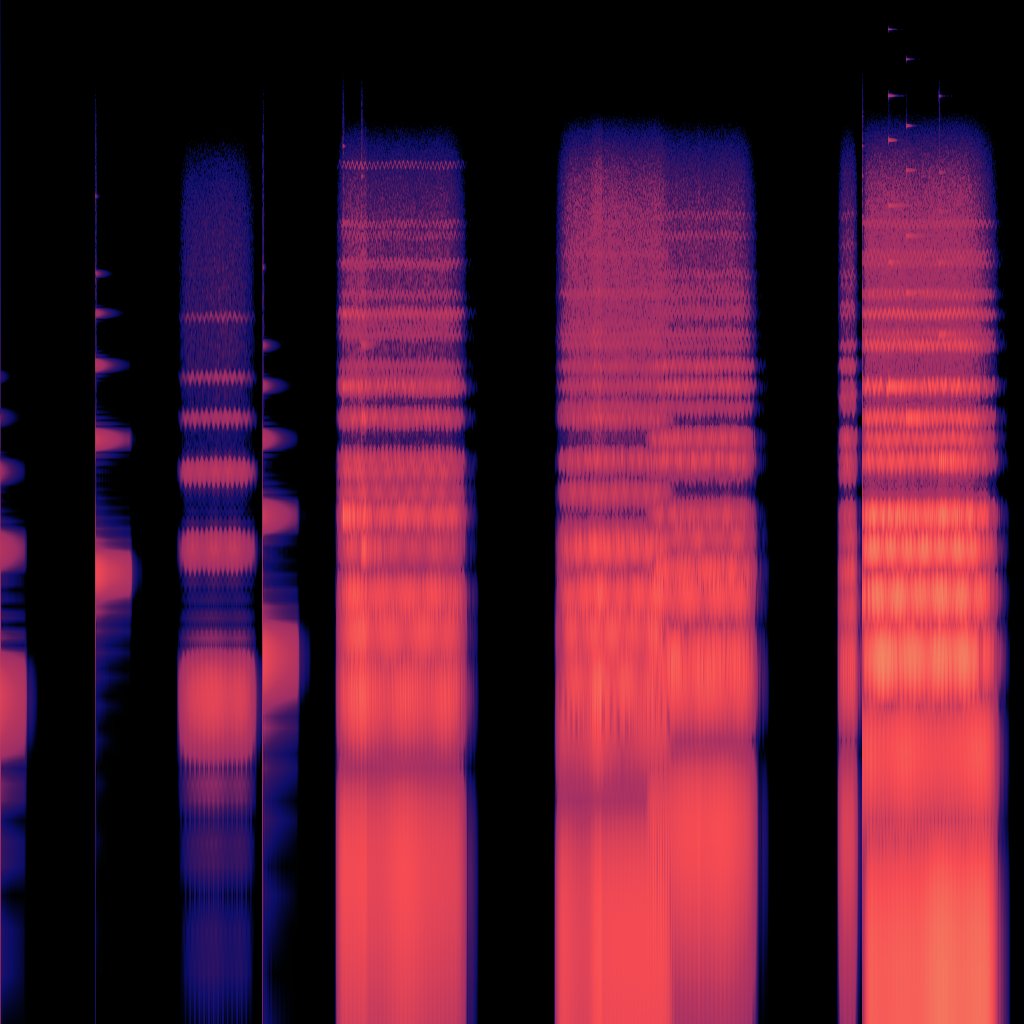
The closing minute of the Oikeiōsis score, from 6:21, drawn by ffmpeg as a spectrogram: time runs left to right, pitch rises on a log scale, brightness is loudness. That picture then went through the pipeline at scale 8. Play it, and the playhead runs along the text. Click the text to jump.
VI Animated eikons
Three passages, frame by frame.
An eikon is the pipeline’s animated format: a header, then one grid of text per frame. Each of these was built from 12 frames a second of one of our films, in both glyph sets. The gate does not pass the same set for all three, and each opens in the set it passed.
| Passage | Glyph set | Grid | Frames | Built in | Motion | Gate | File |
|---|---|---|---|---|---|---|---|
| Oikeiōsis | dense-ref | 192 × 54 | 114 | 1.95 s | 6.3% | low-contrast-garble-risk | .eikon · 1.21 MB |
| Oikeiōsis | D30 | 192 × 54 | 114 | 1.74 s | 12.8% | high-contrast | .eikon · 1.21 MB |
| Becoming | dense-ref | 108 × 72 | 78 | 1.60 s | 37.4% | high-contrast | .eikon · 0.63 MB |
| Becoming | D30 | 108 × 72 | 78 | 1.69 s | 56.4% | low-contrast-garble-risk | .eikon · 0.65 MB |
| Oikos | D30 | 192 × 54 | 90 | 1.41 s | 47.5% | low-contrast-garble-risk | .eikon · 1.10 MB |
| Oikos | dense-ref | 192 × 54 | 90 | 1.32 s | 21.3% | high-contrast | .eikon · 0.96 MB |
VII The quality gate
Every render is graded.
After each render the pipeline counts its own glyphs: how many are heavy, how many light, how many distinct, and gives a verdict. At least 30% heavy and at most 20% light is high-contrast; 30% light or more is a garble risk; anything between is mixed. The same portrait through d30-dense, on black and on white:
flagged · low-contrast-garble-risk
Anastasia, a portrait from the films, composited onto black
passed · high-contrast
the same portrait, composited onto white
“Metrics are guidance, not absolute. Always visually verify with --preview-out. Some scene-class images (architecture, cosmic) may score low on portrait heuristics yet remain visually effective.”the pipeline’s README
VIII What we checked
Run here, on a laptop.
Checked for this page · 2026.11.22 · M3 MacBook Air, 8 GB
- The repository’s tests at a674eaa, 2026.09.24: 10 passed, 1 skipped (tests/test_cli.py:116: “Reference video not available”), 0 failed.
- Every image and film on this page went through the pipeline’s own command,
ascii-pipeline, or for the stage figures its own functions; nothing here was re-implemented. - 10 of 10 sampled eikon frames matched the film at the expected timestamp exactly.
- Each eikon unpacked to the page’s frame files and compared row by row: 564 frames, 0 mismatched rows.
- The staged render in section III is byte-identical to the command line’s.
Found on the way
- inconsistency · ascii_pipeline/eikon.py · ascii_pipeline/downsampling.py Two different D30 charsets. eikon.py’s, which the renderer uses, has 68 entries but 67 distinct glyphs: the comma appears twice. downsampling.py keeps its own copy, with a backslash where the first comma is, and builds the edge-aware downsampler’s luminance table from it. So the downsampler weighs glyphs by a table that does not quite match the set they were drawn from. The effect is small: a shift of one place for three glyphs.
- documentation · README.md The README says “68 glyphs” for D30; there are 67 distinct. It also reports “11 tests, all passing”; on this machine 10 passed and 1 was skipped (Reference video not available).
- inconsistency · ascii_pipeline/presets.py · ascii_pipeline/diagnostics.py Each preset declares its own quality thresholds (stroke-clarity: at least 22% heavy glyphs, at most 24% light), but nothing reads them; one test only checks that they exist. The verdict applies fixed cut-offs to every preset: high-contrast at 30% heavy or more and 20% light or less, a garble risk at 30% light or more, mixed in between.
- design · presets The presets do not agree on polarity. dense-ref (stroke-clarity) puts its densest glyph on the darkest pixels, so it reads as dark ink on light paper; D30 and Braille put their densest glyphs on the brightest pixels, so they read as light on dark. This page shows each the way it was made.
How long it takes
| build-eikon · dense-ref · 192 × 54 · 114 framesOikeiōsis | 1.95 s |
| build-eikon · d30 · 192 × 54 · 114 framesOikeiōsis | 1.74 s |
| build-eikon · d30 · 108 × 72 · 78 framesBecoming | 1.69 s |
| build-eikon · dense-ref · 108 × 72 · 78 framesBecoming | 1.60 s |
| build-eikon · d30 · 192 × 54 · 90 framesOikos | 1.41 s |
| build-eikon · dense-ref · 192 × 54 · 90 framesOikos | 1.32 s |
| d30-dense · scale 4 · 192 × 96a panel of The Formulary | 0.46 s |
| d30-dense · scale 4 · 192 × 96the portrait, on black | 0.41 s |
| d30-dense · scale 4 · 192 × 96the portrait, on white | 0.40 s |
| stroke-clarity · scale 16 · 768 × 384the portrait, on white | 0.20 s |
Wall-clock, one run each, on M3 MacBook Air, 8 GB.
Renders made with ousiaresearch/Risomorphism-1911 at a674eaa, 2026.09.24 from Ousia’s own films and portraits, the score of Oikeiōsis, and a panel of The Formulary. The text files, the .eikon files and their diagnostics are published here as the pipeline wrote them.